sister_raphael: (scissors)
I've finished the grey hood except the buttons and buttonholes, but since they can be worn open anyway, that's it for now.

The liripipe (tail) is stitched on and I'm pretty pleased with it. It's a little patchy looking in some lights because the wool cloth was secondhand to start with. I'm still very happy with it.

I'll be giving it a really good wash to try and even out the dye, but that may or may not help. See how we go.


sister_raphael: (scissors)


A few people have asked what my stitching, the stab and flat fell, look like on the right side. This is what it looks like unwashed and unironed, which tends to make the sewing disappear just that little bit more. It shouldn't be done in a contrasting colour to decorate or pretty it up. Stitches were not a pretty feature.
sister_raphael: (casualfriday)

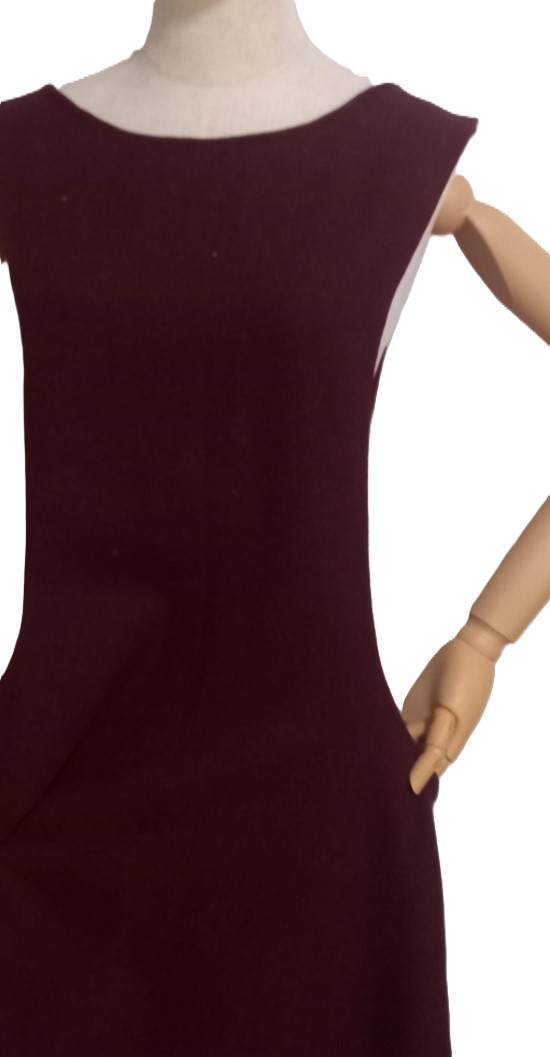
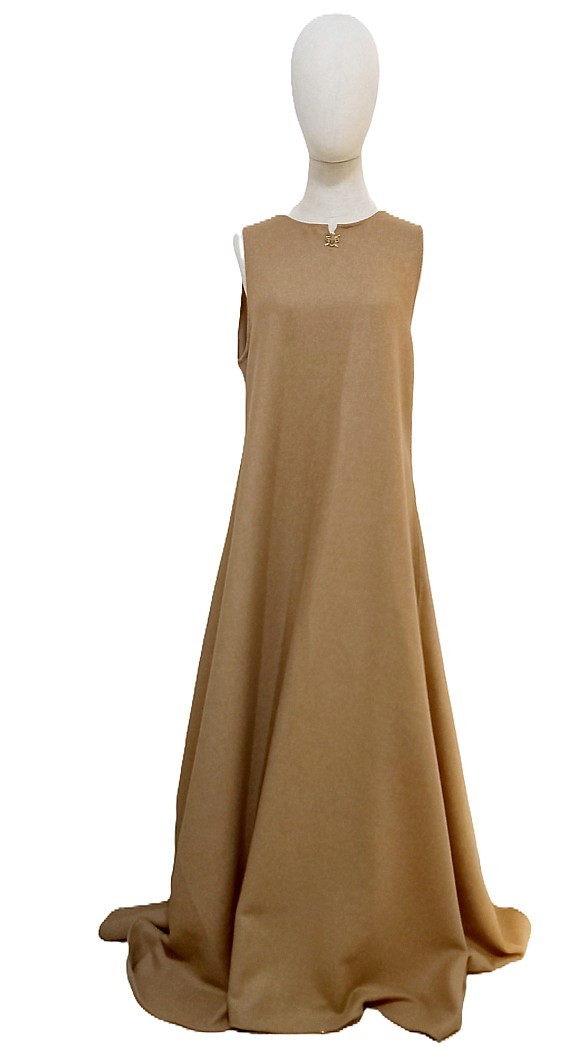
I bought a surcote! Yes, I did!

Just because I sew doesn't mean I can't buy something from a friend!

I love the French wool quality and colour. It's hand finished though I will hand finish all the inside seams and it will receive a fur trim glow up with some jewelled buttons or band down the front.

Some people feel I shouldn't buy stuff because I make my own, but that's just silly! Look at this wool! Just look at it!

Stay tuned for glow-up!

sister_raphael: (homesweethome)

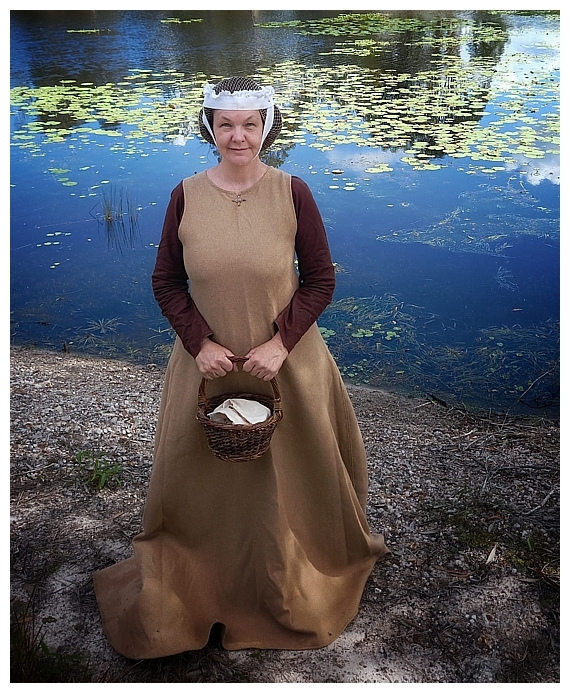
Down where the water lilies grow, wearing my sand wool surcote for the first time!

Another photo from AROW, one of the very few which is usable. My thanks to my friend Nigel for taking this one.

sister_raphael: (Default)

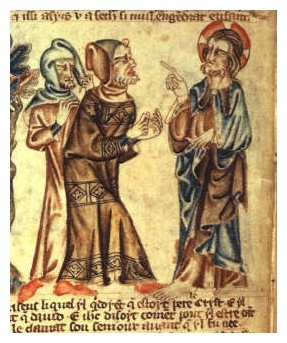
I've started on my next project already, but looking at the finished surcote I can't help feeling it would benefit from some Holkham Bible decoration. I absolutely love the geometric designs.I think there may be an issue though. I've seen them on gownes for women, and on overgownes for men and even what looks like cloaks, but... at this stage, not on any of the women's surcotes. They're all plain.


I've had a pretty thorough look and not a surcote. I am, however, making a gowne/kirtle in a colour that is represented which has red embroidered pattern, so that really may be what I do! I'm not a huge fan of red on woad blue, but it's not all about my modern ideas of fashion, it it?

sister_raphael: (craztcatlady)

Happpily I don't need more than four little red wool buttons for the surcote, so it's on the the buttons then 4 little buttonholes to match!

I'll be honest, I'm not a big fan of wool buttons if I'm trying to make them small, as they really do take a lot of squeezing to get them to a nice size if the wool is a little on the thick side.

sister_raphael: (comeheresaythat)
 
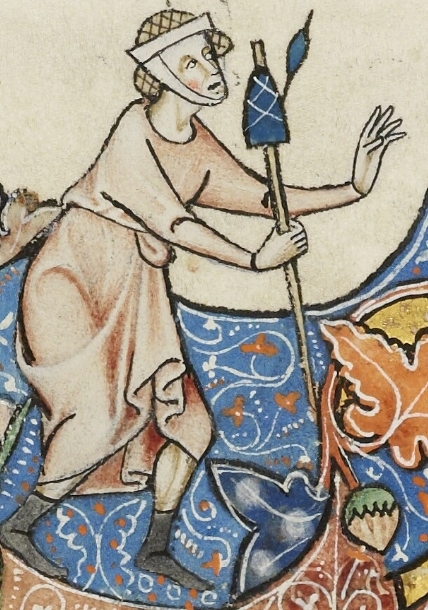
MS Douce 633. Ormesby Psalter, folio 71v

A very cool picture of a lady spinning blue wool. Usually, we see the wool spun first, then dyed, but some wool was dyed in the wool then spun, which is what we are seeing here, I feel. When it was posted up for discussion, there was a huge amount of interest and conversation about the actual practice, the likelihood of actually doing this, the position of the spindle and the choice of other colours in the manuscript itself.

Based on colours used elsewhere which are realistic, I feel this was a deliberate colour choice, although, that said, it is art, not a photograph.
The more I think about this, the more it bothers me. I mean, wouldn't she get blue on her hands while spinning? Just residual, like when working with blue cloth that hasn't been washed.

One experienced spinner and dyer, Rebecca Gilbert added
:

I've found that indigo dye vats, being very alkaline, dye fleece even if it's a little greasy. I assume woad would be the same. I prefer to spin 'dyed in the wool' because it comes out more even color in the end.

Another experienced textile historian and researcher, Amica Spindrift who was kind enough to share her thoughts said this:

What I'd say about this image is that it raises an interesting question about how medieval textile fibres were dyed and I can't give a definitive answer. I know that this is an unusual image - having looked at a lot of medieval depictions of spinning, where they show colour for the fibre, it's almost always white. I also know that that medieval commercial dyers generally dyed woven textiles 'in the cloth' - there are plenty of illustrations and documentary evidence to show large quantities of cloth being dyed. However, other things, such as threads for embroidery and narrow wares were dyed in the yarn. I don't know of any evidence for dying fleece or other raw fibres, but that doesn't mean that it didn't happen. I'd want to find some supporting evidence, however, before I could be sure that this image was intended to depict that practice.

It certainly generated a lot of interesting conversation, and that is where the internet really can shine. Sharing information of like minded souls in a spirit of enquiry and learning together.

The outcome of the chat and ideas? It's non-conclusive. It may be blue for a reason, but really, we can't assume on the basis of this image alone.  The rabbit hole continues here also.


sister_raphael: (boobies)


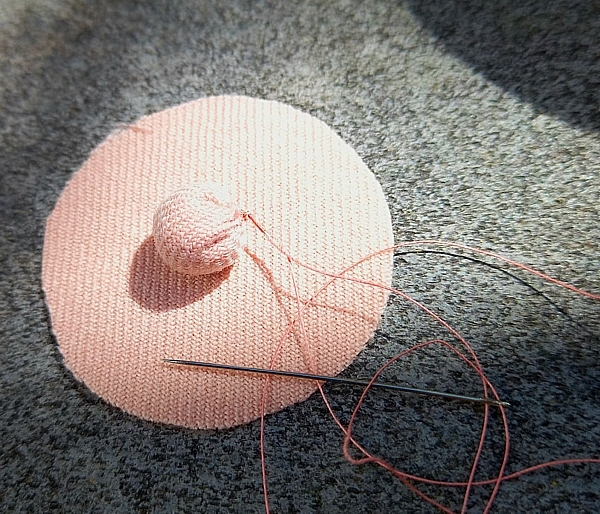
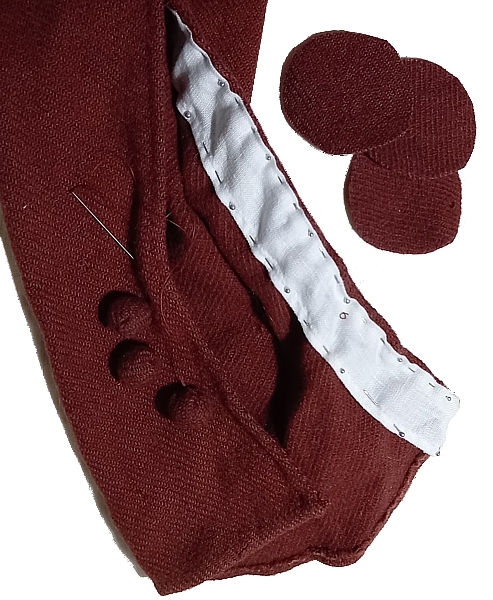
Today I sewed some of the pink, ham-coloured wool buttons and I thought it might be a nice idea to photograph a button sitting on top of the cut circle to demonstrate what size circle I start with and what size button I end up with. A fantastic idea, I thought as it's quite a thin wool, so the buttons are quite small.

Anyway, I sat for fully ten minutes looking at the photos and considering whether there was enough time in my life to deal with the hilarious fall out of putting this on social media tomorrow.

I think there is.

Ironic, isn't it, how the n!pple on the cover of my book was censored and this looks more realistic from a casual glance than the artwork ever did. Even though it absolutely is not.

sister_raphael: (tools)


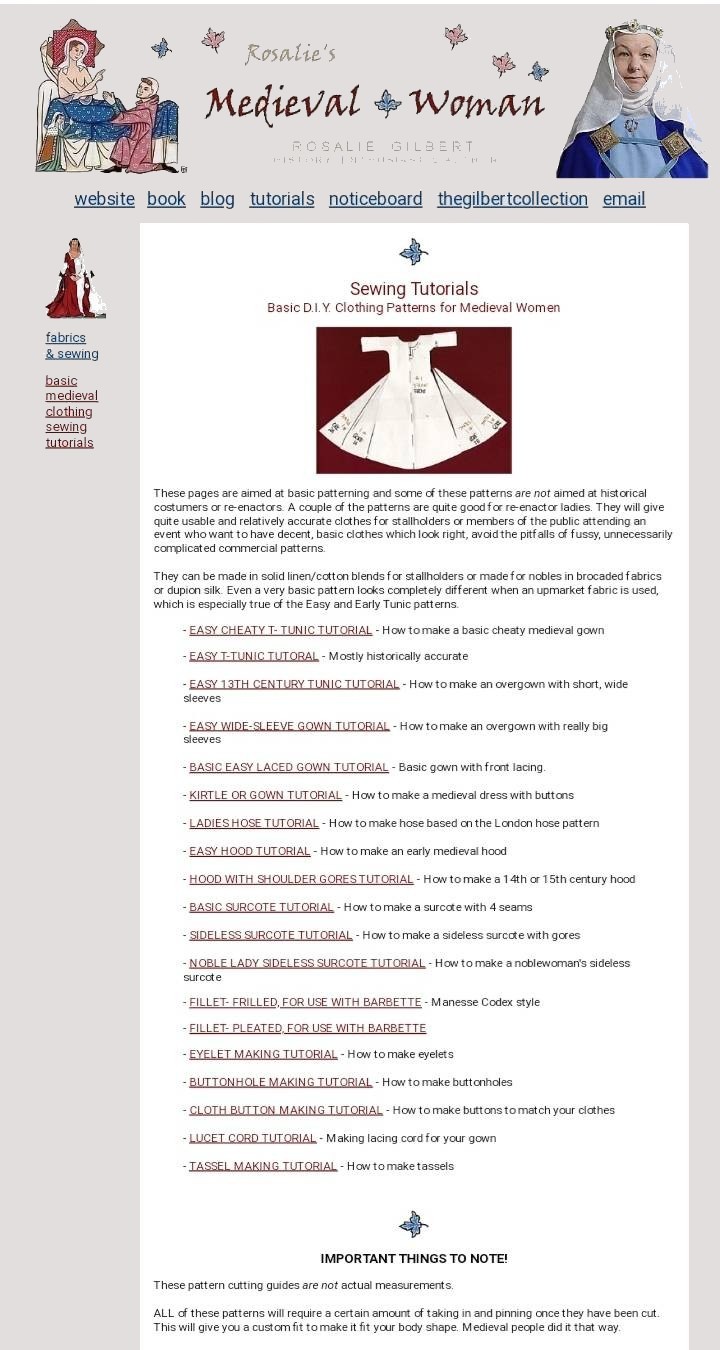
Having some fun tonight updating the tutorials page on my website. I did a share to Faceblergh earlier today and new followers are really enjoying the sewing How To links. I love it when people other than me get excited about medieval clothes.

I'm loving the new banner, which is much like the old one but the photo has been replaced.

sister_raphael: (sewmuchtodo)

While I'm thinking about a few things, I'm sewing again on the pink, wool kirtle which I don't have a real need for at the moment (maybe December?) and although I haven't really decided on the final style, I will need some buttons, so I've cut some to sew in between other things and at lunch time at work.

The buttoned sleeves are a given. Fewer buttons and a couple for the neck means it's early 14th century and I can wear my pie hat and barbette which I'm in love with at the moment, BUT a buttoned front to the navel means I can button all the way up to the elbows and make it a fitted kirtle instead of a looser gowne.

I am completely torn, but I don't have more fabric to make one of each, so it's to be one or the other. I have enough fabric to make a TON of buttons, so I can see that might be where I go. and I don't have a hot weather kirtle in wool and I do have a hot weather gowne in wool in the woad blue.

Decisions, decisions...

sister_raphael: (sewmuchtodo)
 
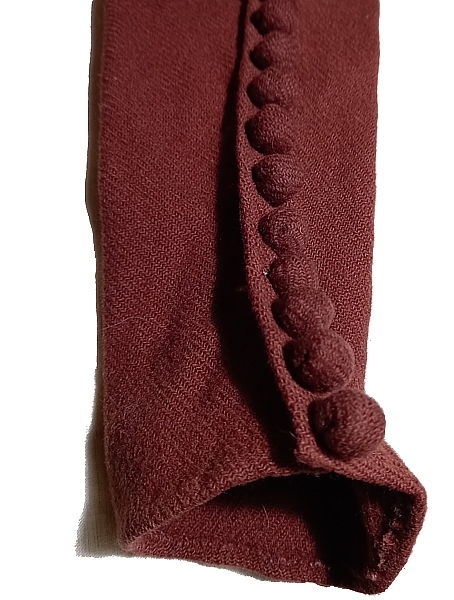
I've finished my brown kirtle glow-up. It now has a laced front to go under surcotes and groovy buttoned sleeves to be 14th century stylish!

I am loving the autumn colours. I have a brown surcote I can wear with this too.

I love autumn colours!
sister_raphael: (sewmuchtodo)


One side complete! The buttons were an extremely snug fit through the buttonholes, but after much wriggling, they're going through. Medieval 14th century button placement is right at the edge of the sleeve opening, not set in further like we do with our modern buttons, but even with them set right on the edge, they're buttoning up to look in from the edge.

I can see that I may not be unbuttoning these to get them on and off...

And here's what they look like when they're all through the buttonholes in a cute little row.


sister_raphael: (scissors)

I've got quite a few kirtles which I've had for quite a while. A few of them are not quite up to my current standard and therefore don't get worn very often. For quite a lot of years, good wools were next to impossible to buy in Queensland, so we re-enactors relied on Op shop buys, old, really thin blankets and whatever did make it to the shops. Sometimes, due to the fabric not being quite what I wanted, I've taken some shortcute with finishing touches, and that's exactly what happened here.

The kirtle is made from a really thin blanket which I dyed with commercial dye. the wool is a little worn in places and there's a tiny hole, but as I planned to use this for working class clothing, I figured that if it looked less than pristine, that was completely okay. I have a secret gripe about re-enactment which goes along the lines of "I really wish every single person in every single group wouldn't bleach and iron their gear all the time" because an entire camp of pristine clothing just isn't realistic to actual life. Life today is not filled with every single person you work with wearing brand new clothing every day. it's actually quite normal for work clothes in trades to have some wear and tear, stains, mending, and be a little rumpled at times.

Anyway, so a work dress with a small hole and some worn patches is okay in my book.

I have bought new wool since than, so this kirtle gets passed over for other things. And there was that whole gaining weight and not fitting thing. Having decided to wear it in a few weeks, I did remember that I had always planned to re-open the lower sleeves and insert buttonholes and make buttons. The kirtle is front laced so it sits nicely under surcotes, but buttoned sleeves would be just that bit nicer and a bit more 14th century fashionable.
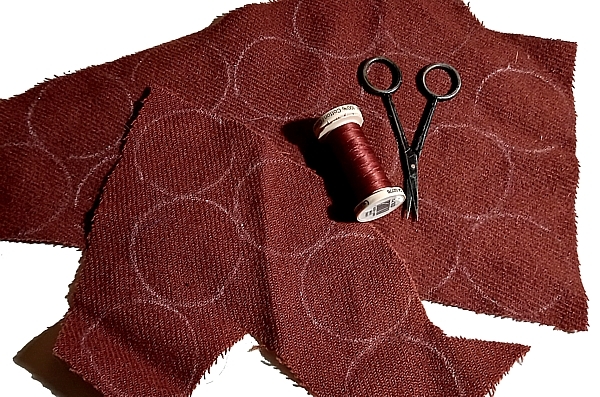


Happily, a good look through my fabric stash found the offcuts I saved in case I actually did make the buttons. The number of buttons per arm was decided by the amount of wool I had left, and worked out at 11 each arm- total of 22 all up.

It really doesn't take too long to cut them out, but with the thicker wool, it does take about 12 minutes each to sew, plus the needle-threading and fiddling around.

That's roughly 3 in 35 minutes if the thread doesn't break and extra time sewing them on.

It sounds like it really doesn't take that much time to make them, but it really is a good few hours plus the buttonholes which I am rather slow at making. Hopefully, this weekend I can get quite a few of them made.

At the moment, I'm still sewing on the linen reinforcing strip on the inner sleeve which is a technique seen in the Museum of London's textile's book.

Still, I've got 2 weeks, so I should be fine!


sister_raphael: (tools)

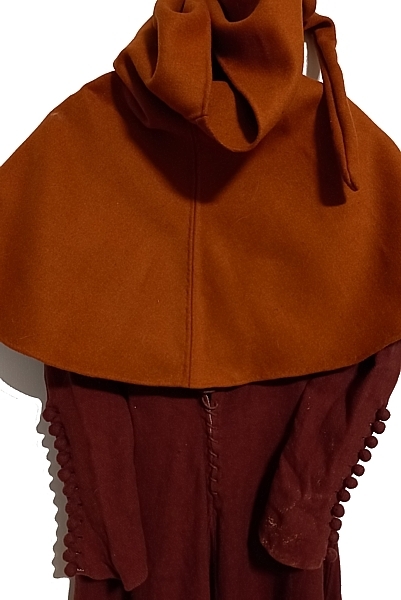
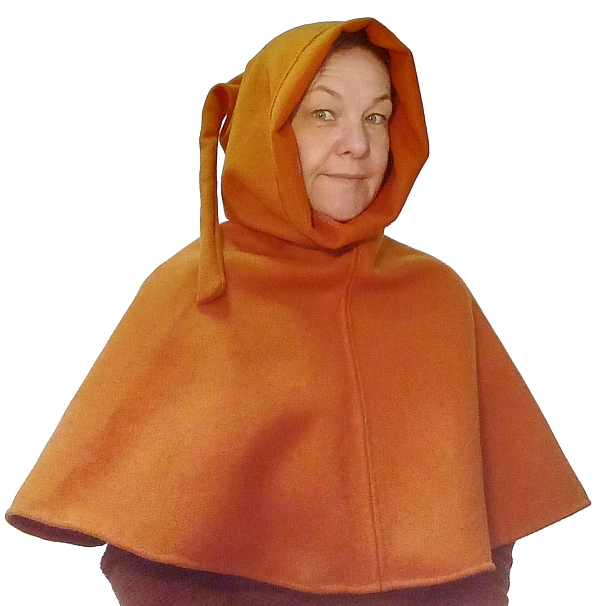
I have to admit that anything in autumn colours makes me happy. Browns more so than oranges, but the wool I used for this is more of a madder brown than a real orange. Getting fabric to photograph properly is the bane of my life some days.

Anyway, I really love the extra long cowl part, and the fact that it's light enough unlined to be not too hot, but simultaneously long and warm enough to stop chills around my shoulders and neck. I'm taking it to an event very shortly, so will test it out properly then.


sister_raphael: (sewmuchtodo)
 Whilst I was doing the big clean and tidy on the weekend, I found a few more unfinished projects and stashed them into a container together so that as I feel enthused, I can work on them and they'll all be together in the mean time.

I did find a wool hood made from 95% wool and 5% cashmire which was not really that far from being finished, so I pulled that out and thought it might make a nice lunchtime project- just something to chip away at until it's done. I did a little yesterday,  and a bit more today and now the inside seams are sewn down and the face hemmed, I only have the bottom of the cowl to go. And it's so snuggly and soft and a really pretty shade of brown.

Now I'm very keen to get it completely finished so I can wear it to a medieval event in a few weeks time. I have just recently seen photos of the site and there's a gorgeous little medieval dock at the dam which would make for great photos, and the hood would be perfect for the outfit I was going to wear! 

The pink, wool kirtle isn't anywhere near finished, so it can wait a little longer.
sister_raphael: (scissors)

We really do think of pink as a "girl" colour and blue as a "boy" colour, though in the medieval world of illuminated manuscripts, you're more likely to see men wearing pink and women wearing blue. There are some images of ladies in pink, like this one at right from the English, Bohun Psalter, folio 162r, from the 14th century.

I'm working on my new pink kirtle which I hadn't planned to be doing just yet.  I hadn't planned for it to be pink, but I was able to buy the wool cheap from a second hand shop and it was so soft and pretty!

I wasn't planning of sewing it just yet either. I was sorting my fabric stash, and there was a small amount of pink, Italian wool, very lightweight and perfect for our Australian summers, but not very much.

By the time I spread it out, thought and thought, found my pattern, placed it this way and that, I figured I may as well cut it out and pin it together since I'd never remember how I had it and it would save me a good hour of trying to remember how I fitted it together. 

So, now it's pinned together and fits well enough to begin stitching. I'm in no real rush for this, but the long, straight seams will make a nice break from buttonholes on other projects. 


Quite probably, this will be an under gown- a kirtle to wear under other surcotes, but it will be light enough to wear as a stand alone garment in extremely hot weather.

Work in progress.

sister_raphael: (supercute)

This afternoon I had my lovely friend come over to try on some outfits for the upcoming Abbey Medieval Festival. She's still suffering with post-Covid laryngitis, but never-the-less we had fun trying on a few outfits and experimenting with veils and getting different looks. Although she's helping out in the marketplace with me, we tried some working class looks and a couple of slightly more well-to-do options.

This one is my favourite! A few hours well spent with good results!

sister_raphael: (fantastic)


A close up and larger than actual size of the hood buttons made of matching wool.

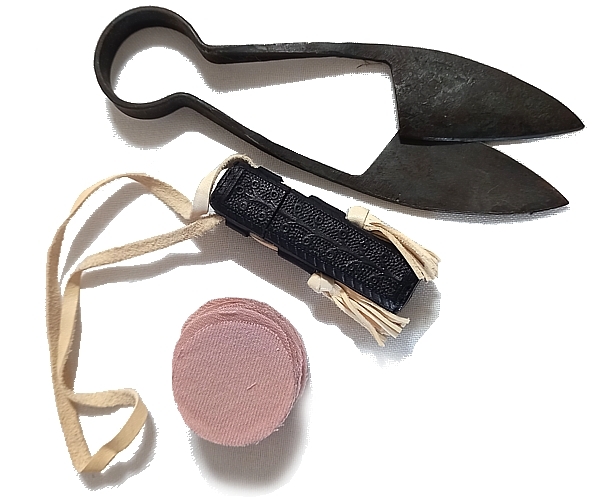
If anyone is interested to see how to make them (and they make cute eyeballs on frogs or cherries or any other round thing one might want for a craft project,) I have a picture tutorial on how to make them here at my button making tutorial.


All you need are the offcuts of the thing you've just made or scraps of anything at all. And something to draw a circle with.

sister_raphael: (scissors)


The last step of the surcote was doing the neck re-inforcing strip in linen for sturdiness and strength. I will still add two eyelets for a brooch pin because it really stops repeated brooch-using from wrecking the fabric. We have no proof that this was done, but as we know that lacings had reinforced eyelet holes to stop the fabric from tearing with repeated use, it's not too far a leap. Medieval art is pretty unhelpful about this, and extant ones are extremely scarce.

It's been a simple but tough project since the wool was quite thick-ish. The gorgeous colour more than makes up for it.


January 2026

S M T W T F S
     12 3
45678910
11121314151617
18192021222324
25262728293031

Syndicate

RSS Atom

Most Popular Tags

Style Credit

Expand Cut Tags

No cut tags
Page generated 3 January 2026 12:46 pm
Powered by Dreamwidth Studios